
The Danegeld Problem
What the Danegeld was
In 991 AD, Viking raiders defeated the Anglo-Saxon army at the Battle of Maldon in Essex. Rather than face continued raids, King Ethelred did something that felt rational at the time: he paid them to leave. Silver, by the shipload. The payment was called the Danegeld - literally, "the Dane tax."
It worked. The Vikings left.
Then they came back. So Ethelred paid again. More silver this time, because the Danes had learned something important: England would rather pay than fight. The first Danegeld in 991 was 10,000 pounds of silver. By 1012, it had risen to 48,000 pounds. Each payment didn't buy peace. It bought a pause, and it set the price for the next raid higher.
If you've watched Vikings, you know the dynamic in its bones. Ragnar Lothbrok doesn't arrive at the gates of Paris to negotiate. He arrives to take. And when the Franks pay him silver to leave, he doesn't think "how generous." He thinks "how easy." He comes back the next season with more ships.
But here's the part the poem misses and the show gets right: the Danes didn't just raid. They settled. They farmed. They married local women, learned the language, built towns. The Danelaw became one of the most productive regions of medieval England. The Normans who conquered in 1066 were Viking descendants who'd become French. Raiders became rulers became the establishment.
Rudyard Kipling distilled this into a single couplet in 1911:
"Once you have paid him the Danegeld, you never get rid of the Dane."
Kipling meant it as a warning against appeasement. But there's a subtler reading, and it's the one that matters for us. The payment didn't just fail to solve the problem. It created an economy around the problem's continuation. And eventually, the economy became the society. The Dane didn't stay because the English kept paying. The Dane stayed because he stopped being a Dane.
Regulation follows the same arc.
The constituency machine
Every regulation, once created, generates a constituency. Not one constituency; several. Compliance consultants who advise on it. Certification bodies who administer it. Lawyers who interpret it. Software vendors who automate it. Internal compliance teams who implement it. Training providers who teach it. Conference organisers who host panels about it.
None of these people are villains. They're doing exactly what you'd expect: building careers around a stable feature of the landscape. A regulation that's been around for ten years doesn't feel like a regulation. It feels like the ground.
The numbers are striking. The global regulatory compliance market hit roughly $21 billion in 2024, growing at 9% annually.[2] In the United States, federal regulations cost an estimated $2.15 trillion per year - about 7% of GDP.[3] Americans spend 7.1 billion hours annually on tax compliance alone: the equivalent of 3.4 million full-time workers doing nothing but paperwork, every day, all year.[4]
These figures represent jobs. Identities. Mortgages. Children's school fees. You cannot cut a regulation without threatening all of them.
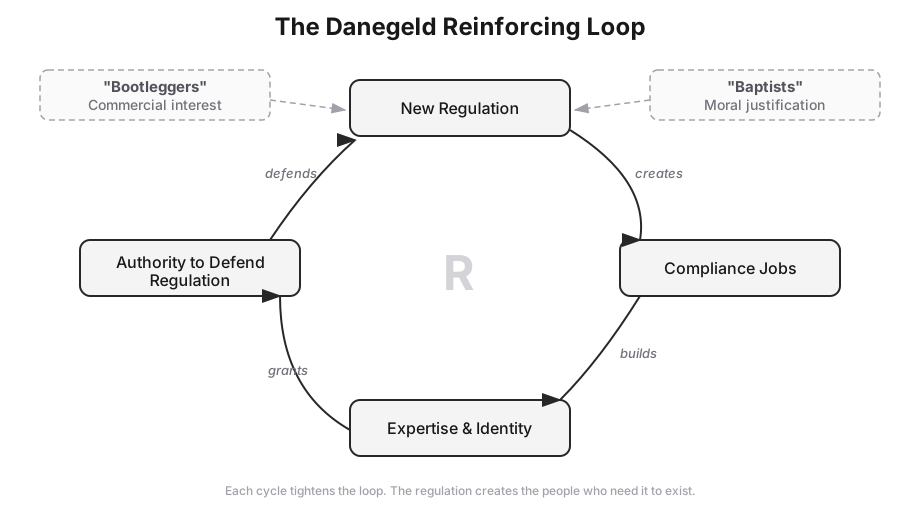
The diagram above shows the reinforcing feedback loop at the heart of the problem. Regulation creates compliance jobs. Compliance jobs create expertise. Expertise creates authority. Authority defends regulation. The loop tightens with every cycle.
Bootleggers and Baptists
The economist Bruce Yandle noticed something about alcohol regulation in the American South. Sunday closing laws - the kind that ban liquor sales on the Sabbath - had two sets of supporters. Baptists, who wanted them for moral reasons. And bootleggers, who wanted them for commercial ones. The Baptists provided the public justification. The bootleggers provided the lobbying money. Neither group needed to coordinate. They just pushed in the same direction for different reasons.[5]
Yandle called this the Bootleggers and Baptists theory of regulation. It explains more about the world than most textbooks.
Every durable regulation has its Baptists: the people who believe, sincerely, that it protects the public. And every durable regulation has its bootleggers: the people who profit from its existence. The Baptists make it politically expensive to repeal. The bootleggers make it economically expensive. Together, they make repeal nearly impossible.
Take the Sarbanes-Oxley Act, passed in 2002 after the Enron and WorldCom scandals. The Baptists: investor protection advocates who wanted corporate accountability. The bootleggers: the compliance industry that materialised overnight. By 2007, annual compliance costs ranged from $860,000 to $5.4 million per company. A GAO report in 2025 confirmed these costs remain disproportionately burdensome for smaller firms - precisely the companies least likely to commit Enron-scale fraud.[6] But try repealing SOX now. The compliance infrastructure is a constituency. It votes. It lobbies. It writes op-eds about corporate governance. It's not wrong, exactly. It's just self-interested in a way that happens to align with what it believes.
Why the bonfire never burns
Every UK Prime Minister since the 1990s has promised a "bonfire of regulations." None has delivered.
Michael Heseltine promised to "hack back the jungle of red tape" in 1992. David Cameron launched the Red Tape Challenge in 2011 and pledged to leave office "with fewer regulations than when his government entered." The results were modest: valets were exempted from lorry driver tests. The size of No Smoking signs was relaxed. Small businesses saved £300 million.[7] Out of a regulatory landscape worth hundreds of billions.
Boris Johnson promised radical post-Brexit reform. His first list of 587 pieces of legislation to be revoked turned out to be a spring clean: most had already expired or were redundant. Temporary rules from the 2001 foot-and-mouth crisis. Regulations about things that no longer existed. The bonfire burned old furniture nobody was sitting on.[8]
Then came DOGE. Elon Musk aimed to slash 100,000 federal regulations using AI to identify rules that were "outdated, redundant, or legally unnecessary." Estimated savings: $3.3 trillion annually. The actual result: disputed claims of $150 billion in cuts, a string of legal challenges, and Musk's departure within months.[9]
The pattern is identical every time. A leader arrives promising to cut. The people in the room who understand the regulations are exactly the people whose jobs depend on them. They explain - persuasively, and often correctly - why this particular regulation is essential. Each individual defence is reasonable. The aggregate effect is paralysis.
This is reinforcing feedback loop in a suit, exactly as Donella Meadows described in her work on systems dynamics. The loop tightens with every cycle.
The other side of the coin
Here's the trade-off the deregulation zealots ignore: sometimes the Dane is real.
In 2006, changes to UK building regulations - intended to facilitate energy efficiency at lower cost - made combustible cladding on tall buildings effectively legal. The change was part of a broader deregulation push. Fewer rules, faster construction, lower costs.
On 14 June 2017, Grenfell Tower caught fire. Seventy-two people died. The inquiry found that the government had been "well aware" of the risk from dangerous cladding but had allowed its "enthusiasm for deregulation to dominate its thinking to such an extent" that matters of life safety were "ignored, delayed or disregarded."[10]
Thirty years of warnings. Ignored because they came wrapped in red tape, and red tape was the enemy.
This is Sowell's trade-off in its most brutal form. You cannot have both maximum deregulation and maximum safety. You cannot cut red tape and guarantee that none of it was load-bearing. The people who promise you can are selling something. And the people who died at Grenfell paid the price for their sales pitch.
The design problem
So we're stuck. Regulation accumulates because every rule creates its own defenders. Deregulation fails because every cut has potential victims. The system ratchets in one direction: more rules, more compliance, more cost, more constituency, more rules.
Is there a way out?
Probably not a clean one. But there are principles worth naming.
Sunset clauses. Every regulation should have an expiry date. Not because all regulations are bad, but because the ones worth keeping should be worth re-arguing for. A regulation that can't survive its own review probably shouldn't survive.
Asymmetric scrutiny. New regulations should be easier to create than old regulations are to preserve. Currently the burden of proof falls on the reformer: "prove this regulation is unnecessary." Flip it. The burden should fall on the incumbent: "prove this regulation is still necessary." The Danes should have to justify their tribute.
Separate the Baptists from the bootleggers. When someone argues for preserving a regulation, ask one question: do you earn money from this regulation's existence? Not to dismiss them. They might still be right. But to know what you're hearing. The consultant arguing for GDPR's preservation has different incentives from the privacy advocate arguing the same case. Both deserve a hearing. Neither deserves to be confused with the other.
None of these are solutions. Sowell was right: there are no solutions, only trade-offs. But these are better trade-offs than the ones we're currently making.
The ground beneath her feet
The GDPR consultant is still working. Her industry will be worth $10 billion within five years. She's good at her job. Her clients are better protected because of her.
She is also a structural feature of a system that cannot reform itself. Not because she's blocking reform. Because her existence, and the existence of thousands like her, is the block. The regulation made her. And now she sustains the regulation. Not through lobbying. Not through corruption. Just by being competent, employed, and rational.
Kipling warned about the Dane. But he told the wrong story. The Dane didn't stay because the English kept paying. The Dane stayed because he stopped being a Dane. He married. He built. He governed. Ragnar's great-grandchildren aren't raiders. They're Normandy. They are England.
The compliance industry isn't a parasite. It's a civilisation that grew where the regulation planted it. And that's precisely why you can't tear it out.
Related reading:
- Trade-offs Thinking - Sowell's framework for understanding why every policy comes with costs
- The Fundamentals of Systems Theory - Reinforcing feedback loops and why systems resist change
- Move Fast and Break Things? Not in Healthcare - When the tension between speed and safety is productive