
Trade-offs Thinking
Pick any debate: healthcare, immigration, education, housing. Within minutes, someone will propose "the solution" - and someone else will call it dangerous, naive, or cruel.
We assume the disagreement is about values. They don't care about the poor. They don't understand economics. They're ideologues. They're heartless.
But what if most disagreements aren't about values at all? What if people largely want the same things - less suffering, more flourishing, a functioning society - and the real divide is how they weigh the inevitable costs of getting there?
Thomas Sowell, an economist and social theorist, compressed this insight into seven words: "There are no solutions, only trade-offs."[1]
It sounds pessimistic. It's actually liberating.
There is no free lunch. Every policy, every decision, every "solution" comes with costs - usually paid by someone other than the person proposing it. Sowell's insight isn't cynicism; it's the starting point for honest thinking. Once you accept that tradeoffs are inevitable, you can finally ask the right question: which tradeoffs are worth making?
Who is Thomas Sowell?
Thomas Sowell is an American economist and social theorist, now in his nineties, who has spent six decades studying how societies make decisions. Raised in Harlem, educated at Harvard, Columbia, and the University of Chicago, he has written over forty books on economics, history, and culture.
His work defies easy political categorisation. He began as a Marxist, became a free-market economist, and has spent his career irritating ideologues on all sides by following evidence rather than tribes. What unites his thinking is a deep scepticism of grand plans and a respect for the hidden costs that planners ignore.
The "no solutions, only tradeoffs" insight appears throughout his writing, but is stated most directly in A Conflict of Visions (1987), his study of why people with similar intelligence and goodwill reach opposite conclusions about policy. For Sowell, this isn't a throwaway line - it's a foundational claim about how reality works.
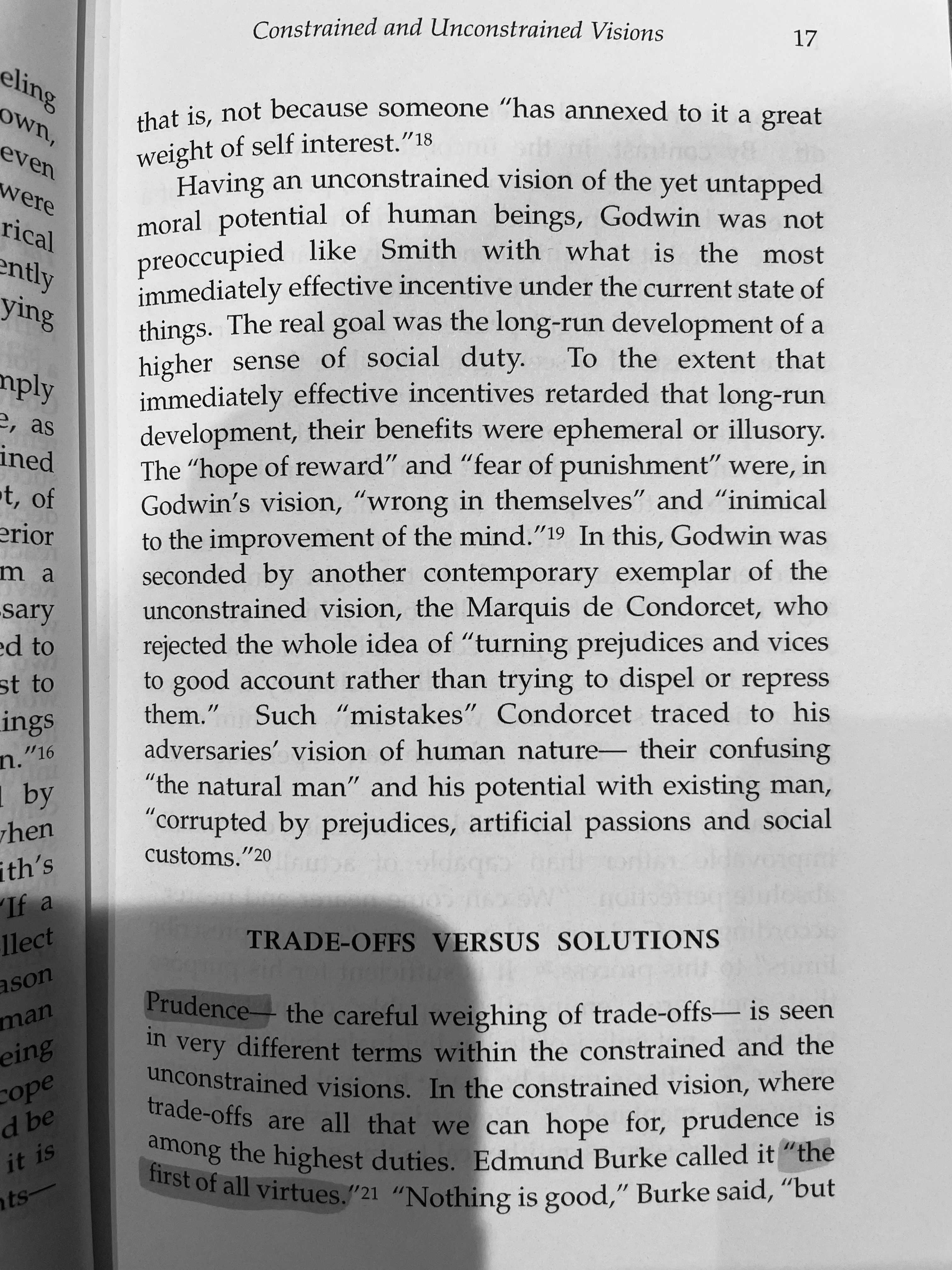
Where does this idea come from?
Sowell didn't invent the concept. Economists have long spoken of opportunity cost - the idea that choosing one thing means forgoing another. Every pound spent on X is a pound not spent on Y. Every hour devoted to this is an hour stolen from that.
But Sowell extended the insight beyond economics into politics, policy, and everyday life. He noticed that public debates almost never acknowledge costs. We argue about benefits - who gains, how much, how visibly - while the costs remain invisible, diffuse, or delayed. The person who points out the tradeoff is accused of not caring about the problem.
This asymmetry, Sowell argues, is how bad policies survive.[2]
What does "no solutions, only tradeoffs" actually mean?
Start with a simple observation: resources are finite. Time, money, attention, energy - there is never enough of any of them to do everything we might want. This means every choice to do one thing is simultaneously a choice not to do something else.
This is obvious at the individual level. If you spend Saturday hiking, you're not spending it with your elderly parents. If you take the higher-paying job in another city, you lose proximity to your friends. No one pretends these choices are costless.
But something strange happens when we move to collective decisions. Suddenly, costs disappear from the conversation.
The vanishing cost
Consider a proposal to raise the minimum wage. Advocates emphasise the benefits: workers earn more, poverty decreases, dignity is restored. Opponents are cast as heartless - why wouldn't you want people to earn a living wage?
But the tradeoff doesn't vanish because we refuse to name it. Some businesses will hire fewer workers. Some will raise prices. Some will close. Some jobs that might have existed won't. These aren't predictions of doom - they're acknowledgments that you cannot raise the cost of something without affecting how much of it gets purchased.
Sowell's point is not that minimum wage increases are wrong. His point is that the debate should include the costs. If we raise wages by X, and some number of jobs are lost or never created, is that tradeoff worth making? Maybe yes, maybe no. But pretending the cost doesn't exist isn't compassion - it's evasion.
Why we hide tradeoffs
Three forces conspire to make costs invisible:
Concentrated benefits, diffuse costs. The people who gain from a policy know exactly how much they've gained. The people who pay often don't know they're paying at all. A tariff protects 10,000 steel jobs - those workers know, and they vote accordingly. It raises prices for 300 million consumers by a tiny amount each - they barely notice.
Visible beneficiaries, invisible victims. We can photograph the family helped by a new housing programme. We cannot photograph the families who might have been helped by whatever we didn't spend that money on. The seen is always more compelling than the unseen.[3]
Time delays. Benefits often arrive immediately; costs often arrive later. A debt-funded stimulus boosts the economy now. The interest payments come due over decades. By then, different politicians are in charge, and no one connects cause to effect.
The question behind the question
Once you accept that tradeoffs are inevitable, the nature of disagreement changes.
The real question is never "should we solve this problem?" Everyone wants to solve problems. The real question is: "Given that any action has costs, which costs are acceptable, and who should bear them?"
This is harder. It requires honesty about what we're giving up. It forces us to prioritise - to say that some goods matter more than others, that some people's interests will take precedence. It makes explicit what solutionist thinking keeps hidden.
But it's the only way to think clearly about collective choices.
Tradeoffs in practice
The security queue
After September 11th, airports introduced extensive security screening. The benefit was clear: reduced risk of hijacking. But what was the cost?
Millions of hours spent waiting in queues. Missed flights. Shifted travel patterns - some people now drive instead of fly for shorter trips. And driving, statistically, is far more dangerous than flying. One economist estimated that the additional road deaths caused by people avoiding air travel exceeded the lives saved by enhanced security.
This isn't an argument against airport security. It's an observation that "making flying safer" had a cost paid in a different currency, by different people, in ways that never appeared in the same headline as the security improvements.
"Tax the super-rich more"
This sounds obvious. A tiny number of people hold vast wealth while public services crumble. Why not take more from those who won't even notice it's gone?
The tradeoffs are real, even if contested. Capital is mobile - raise taxes high enough, and some wealth moves elsewhere, leaving you with a smaller share of a smaller pie. Investment patterns shift - money that might have funded new businesses flows instead toward tax avoidance or jurisdictions with friendlier regimes. Charitable giving may decrease if the taxed wealth would otherwise have been donated.
Are these costs worth bearing? Perhaps. Perhaps the benefits - reduced inequality, funded public goods, a sense of fairness - outweigh them. But the honest debate isn't "should we help people?" versus "should we protect billionaires?" It's: "Given these tradeoffs, what level of taxation optimises for what we actually value?"
"Free healthcare as a human right"
Who could argue against this? Healthcare is essential. People shouldn't die because they're poor.
But "free" is a description of price, not cost. Healthcare still requires doctors, nurses, equipment, buildings, research. These resources must come from somewhere - either taxes, or borrowing, or redirecting spending from other priorities.
And "free at the point of use" creates its own tradeoffs. Demand rises when price falls to zero. Queues lengthen. Rationing happens - just through waiting times rather than wallets. Innovation may slow if price signals disappear. The workforce must be paid, trained, and retained in competition with other countries.
None of this means universal healthcare is wrong. Many countries have decided these tradeoffs are worth making - that the gains in equity and security outweigh the costs in efficiency or choice. But framing it as a "right" that simply needs recognising, rather than a system that requires difficult choices about resource allocation, isn't moral clarity. It's evasion of the actual question.
An analogy: the seesaw
Imagine policy decisions as a seesaw. Push down on one end - reduce one problem - and the other end rises. You cannot push both ends down simultaneously. The seesaw doesn't care about your intentions; it responds to physics.
Solutionist thinking imagines we can somehow pin both ends down at once if we're clever enough, caring enough, or spend enough. Tradeoff thinking accepts the seesaw and asks: which end matters more, and how much rise on one side is acceptable to achieve a fall on the other?
What tradeoff thinking is not
Misconception: "This is just cynicism dressed up as wisdom."
Reality: Tradeoff thinking isn't about lowering expectations or abandoning ambition. It's about directing effort where it can actually succeed. Acknowledging that a policy has costs isn't the same as opposing the policy - it's the precondition for weighing whether the benefits justify those costs. The cynic says nothing can be done. The tradeoff thinker asks what can be done, and at what price.
Misconception: "This is a conservative argument against change."
Reality: Sowell's framing is often claimed by the political right, but the logic is politically neutral. Inaction has tradeoffs too. Refusing to reform a broken system has costs - just different ones than reforming it. The question is never "change versus no change" but "which set of tradeoffs do we prefer?"
Misconception: "If we just had enough resources, tradeoffs would disappear."
Reality: Scarcity isn't a policy failure - it's a feature of reality. Even the wealthiest societies must choose between competing goods. More for healthcare means less for education, defence, or tax relief. More time for work means less for family. Abundance reduces the severity of tradeoffs but never eliminates them.
Misconception: "Tradeoff thinking leads to paralysis."
Reality: The opposite. Pretending there are no tradeoffs leads to policies that fail in predictable ways, followed by confusion about why. Seeing tradeoffs clearly allows you to choose deliberately, prepare for costs, and adjust when the balance shifts.
How to use this
When evaluating any proposal - political, professional, personal - ask three questions:
-
What is being given up? Every "yes" is a "no" to something else. If the cost isn't named, it hasn't disappeared - it's been hidden.
-
Who pays? Benefits and costs rarely fall on the same people. The beneficiaries are usually visible and vocal. The payers are often diffuse, silent, or not yet born.
-
Compared to what? A policy isn't good or bad in isolation - only compared to alternatives, including doing nothing. "This has problems" is not an argument unless the alternatives have fewer.
In conversation:
When someone presents a solution as costless, don't argue - ask. "What would we have to give up?" "Who might be worse off?" "What could go wrong?" These aren't gotcha questions. They're the questions any honest proposal should already have answered.
In your own decisions:
The same logic applies to career choices, relationships, and how you spend your time. There is no path without sacrifice. Clarity comes not from finding the option with no downside, but from knowing which downsides you're willing to accept.
The payoff:
Tradeoff thinking won't make you popular at dinner parties. But it will make you harder to fool - by politicians, by salespeople, by your own wishful thinking. And it transforms frustrating disagreements into something more productive: a conversation about which costs we're willing to bear, rather than a shouting match about who cares more.
Go deeper
Thomas Sowell's key works:
- A Conflict of Visions: Ideological Origins of Political Struggles (1987) - The source of the tradeoffs insight
- Basic Economics (2000) - Tradeoff thinking applied to economic policy, written for non-economists
- The Vision of the Anointed (1995) - How good intentions produce bad policies when tradeoffs are ignored
Related ideas:
- Frédéric Bastiat, "That Which Is Seen and That Which Is Not Seen" (1850) - The original articulation of hidden costs
- The Systems Paradigm - How interconnected thinking reveals tradeoffs that linear thinking misses
- The Fundamentals of Systems Theory - Understanding feedback loops and unintended consequences
Be a trade-offs thinker.